

How Can Kids Stand Up for a Friend Who Is Being Teased?
When a child sees a friend being teased, they may know it feels wrong without knowing what to do. Should they say something? What if the other children turn on them? What if their friend would rather everyone stopped looking?
Standing up for a friend does not have to mean a dramatic confrontation. A child can refuse to join in, invite their friend to play, check on them afterward, or tell a trusted adult. Those small actions can help someone feel less alone. The important thing is to give children choices that are kind and safe.
First, listen to what your child saw
If your child tells you that someone was teased, start with curiosity: “What happened?” “What did the other children say?” “How did your friend seem afterward?”
Try not to rush straight to “You should have said something.” Your child may already feel guilty about freezing or walking away. Listening first helps you understand whether this was a single unkind remark, repeated teasing, exclusion, or something that made anyone feel unsafe.
Children may also be unsure whether a comment was meant as a joke. You can ask, “Did the person it was about seem to find it funny?” That question helps your child think about the effect of the words, not just the speaker’s intention.
Not every disagreement is bullying, but children don’t need to settle on a label before asking for help. StopBullying.gov advises adults to talk with children about hurtful behaviour, safe responses, and when to involve a trusted adult.

Teach a few ways to help, not one “brave” response
Some children will feel comfortable saying, “That’s not kind.” Others won’t, especially if several children are teasing or the situation feels threatening. A child who cannot speak up in the moment has not failed their friend.
You can offer a short menu of options:
- Don’t join in. They can choose not to laugh, repeat the comment, or encourage the teasing.
- Invite the friend away. “Do you want to play with us?” can change what happens next without starting an argument.
- Stay beside them. Sitting together or walking with them can show quiet support.
- Check in afterward. A simple “Are you okay?” gives their friend a chance to talk.
- Get an adult. If the teasing continues, becomes threatening, or feels unsafe, a teacher or another trusted adult needs to know.
It helps to talk through these choices before your child needs them. Ask which one would feel possible at school or on the playground. Their answer may be different from the one you would choose, and that is okay. The goal is to help them act safely, not to give them a line they must deliver perfectly.
StopBullying.gov’s advice for kids includes showing kindness to the child being hurt and telling a trusted adult what happened.
What if your child froze or walked away?
Many adults have thought of the right words only after an uncomfortable moment has passed. Children do too. If your child says, “I didn’t do anything,” try, “You can still help your friend now.”
They might ask their friend how they are feeling, invite them into a game the next day, or tell a teacher what they saw. Helping afterward counts. It also gives you an opportunity to practise for another time without making your child feel ashamed.
You could say: “If it happens again, would you rather go and stand with your friend, or come and get me or your teacher?” Having two clear options can feel less overwhelming than being told to “stand up for them.”

When should an adult step in?
A child should never be expected to manage repeated or intimidating behaviour alone. If teasing continues, involves threats or physical harm, or leaves a child afraid to go to school or an activity, speak with the adults responsible for that setting.
Help your child tell them what happened in plain words: who was there, what was said or done, where it happened, and whether it has happened before. Your child can go with their friend to speak to a teacher if their friend wants company. They can also tell an adult themselves when they are worried about someone’s safety.
Make it clear that asking for help is not “getting a friend in trouble.” It is letting someone with the responsibility and ability to intervene know what is happening. Children can be caring friends without carrying an adult’s job on their shoulders.
Help children see the person, not the difference being teased
Teasing often focuses on something that makes a child stand out: the way they look, speak, dress, learn, or play. We do not have to pretend people are all the same to teach kindness. We can help children understand that differences are ordinary—and that nobody deserves to be mocked for theirs.
Ask your child what they appreciate about their friends. Perhaps one makes up imaginative games, remembers every animal fact, or is always ready to share. Specific conversations like these are more useful than simply saying “everyone is special.” They encourage children to notice who someone is beyond the thing another person pointed out.
This is also a chance to model your own response. If your child repeats an unkind comment they heard, you can be clear without shaming them: “I’m glad you told me. Those words could hurt someone. What else could we say about your friend?”
Practise the conversation through a story
It can be easier for a child to talk about a fictional character than about an incident at school. Stories give you a little breathing room: you can pause, wonder what a character is feeling, and consider what might help.

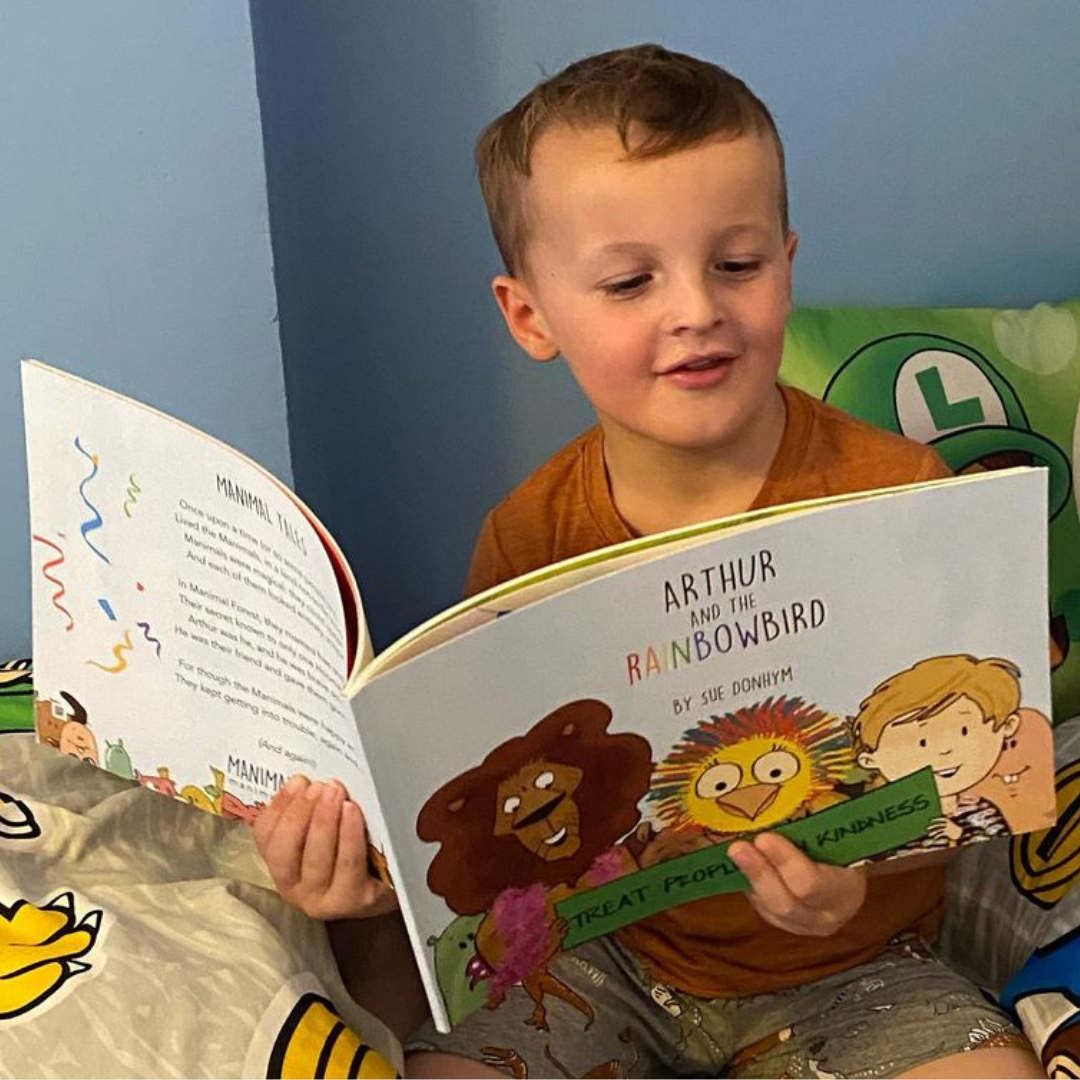
In You and the Rainbowbird, CattyCat and Crew tease Rainbowbird for being different. Your child becomes part of the story and helps support Rainbowbird, while the Manimals come to appreciate what makes each of them unique. The book can include your child’s name, a character chosen to represent them, and a personal printed message. It is listed for ages 4–10.
The story offers a natural starting point for questions such as:
- “How do you think Rainbowbird felt when the teasing started?”
- “What could a friend do if they noticed Rainbowbird was upset?”
- “Who could help if the teasing didn’t stop?”
- “What makes each of the Manimals interesting?”
You do not need to turn reading time into a lesson or quiz. Follow your child’s curiosity. They may want to talk about Rainbowbird, remember something that happened to a friend, or simply enjoy the story and return to the conversation another day. You can preview You and the Rainbowbird here.
Standing up for a friend is not always about finding the boldest words. Sometimes it is an invitation to join a game. Sometimes it is sitting beside someone who has been left out. Sometimes it is telling an adult, “I’m worried about my friend.” Children deserve to know that all of those can be ways to show they care.
Who Will You Make a Book For Today?
General Questions
Manimal Tales is a publisher of beautifully illustrated personalized books. We have personalized books for children and adults. From birthday books to new baby tales, and from bedtime stories to ABC books, we have custom books for all occasions!
We even offer PhotoStories, our personalized picture books with photos.
At Manimal Tales, we fervently believe every child should be the hero of their own story!
Personalized books (or custom books as they are sometimes referred to) allow the reader to become the hero of the story - literally.
The main character in the story is the reader / receiver of the book, and is represented by an avatar that looks like them. There are usually lots of additional personalized details printed in the stories, including the receiver's name, age, family members and more.
Our PhotoStories offer a whole new level of personalization by allowing you to add your own photos into the story and have them printed out with the book.
Browse through our collection of custom books to see which ones work for your loved ones!
It's super easy to personalize your own book!
Browse through our collection of personalized stories and select the titles you want. On the product page, add the details required to personalize the book (name, age, family members, photos etc.). You can then preview the entire book before you buy, so you know exactly what you're going to get!
Once you're satisfied, add the book to your cart, enter your payment details and your unique, one-of-a-kind personalized book will arrive on your doorstep in 6 to 9 days!
The short answer is that it depends on the personalized book title in question!
All books will have your loved one as the main protagonist and their name will be printed on the book cover as well as in the story.
In some of our books like Dreamland and What Will I Be? the (the An ABC Story) your loved one's name is printed on every page.
In our Manimal Tales series, in addition to your child's name, you can select an avatar that looks like your child.
In our custom baby tales, Your Baby's Story and Your Baby's Story (Sibling version), you have to enter names and select avatars for the parents and the siblings as well.
And for our PhotoStories, you can further customize the books by uploading and adding your own photos directly into the book. The stories have been written to incorporate the photos as part of the story itself.
Whichever personalized book you do choose, we guarantee your loved one's will love our custom tales just as much as we do!
We have books for all ages and occasions! On the menu bar at the top of the page you can filter through our collections of personalized books by a variety of different criteria.
We have personalized books for:
We also offer custom books with engaging stories about:
- Standing up for your beliefs
We have personalized books across all ages:
Lastly we have our PhotoStories, which allow users to upload photos and have them become part of the story!
Nothing beats getting a book with your name on it!
Personalized books are treasured and loved by all, and make great keepsakes.
We offer custom books for all occasions, ensuring you will always find a book to meet your needs.
You can always reach us by filling out our Contact Form.